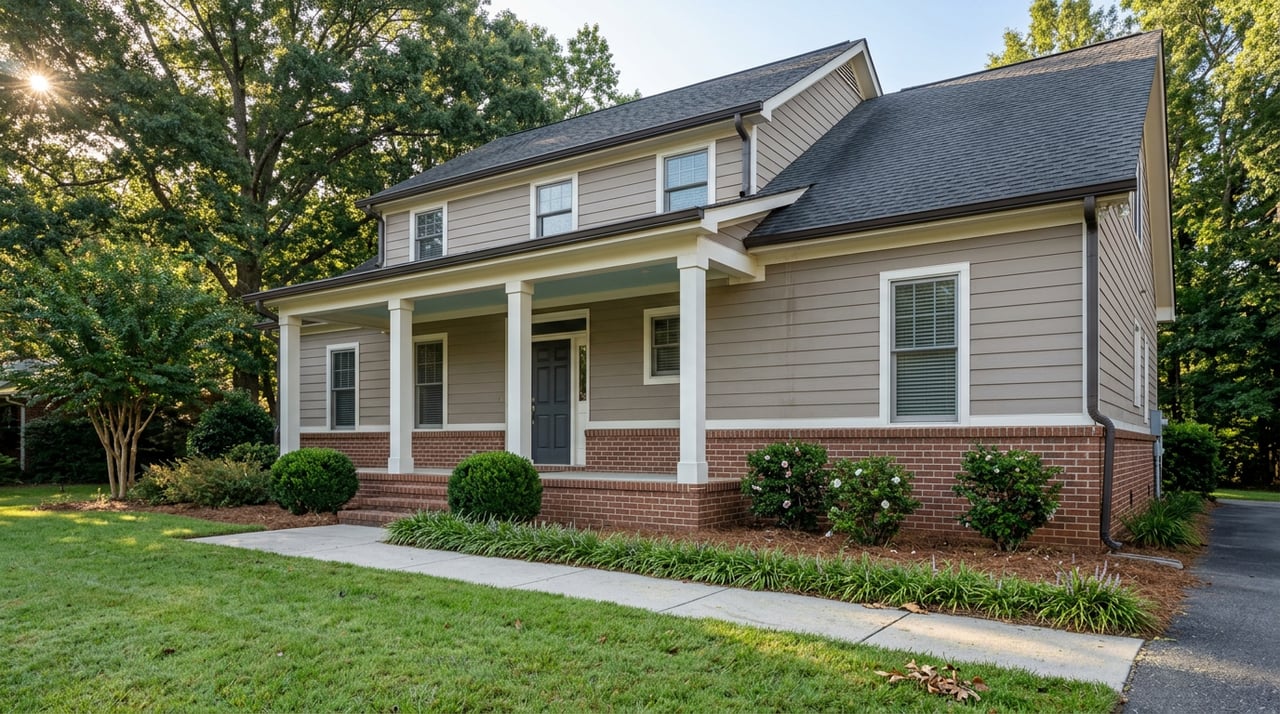
Powdersville Property Taxes and Utilities: What to Check
August 20, 2026
August 20, 2026
Stand at the entrance sign for Holly Tree or drive the loop through Yorkshire Farms and every home reads the same way on paper: Powdersville, SC. The listing photos look interchangeable. The school district line is the same. But Powdersville isn't a town in the legal sense. It has no city hall, no zoning board, and no single water or sewer utility that actually treats what leaves your house. It's an unincorporated census-designated place that the post office started letting people call "Powdersville" for mail purposes back in 2008, even though the underlying parcels sit across three different jurisdictions.
That distinction sounds like paperwork trivia until you're the one comparing two homes a half mile apart and discovering they answer to different tax assessors, different sewer providers, and in some cases, no sewer connection at all.
Most of Powdersville sits in the northeastern tip of Anderson County, but the area bleeds into Greenville and Pickens counties along its edges, bordered loosely by the Saluda River, Pickens County to the northwest, and I-85 to the southeast. Because there's no incorporated city government, every building permit, zoning question, and inspection routes through Anderson County Building & Codes rather than a local Powdersville office. There is no Powdersville equivalent of a city planning department to call.
The mailing quirk makes this harder to spot, not easier. In 2008 the postal service began allowing "Powdersville" to appear on mail for the 29611, 29642, and 29673 zip codes, which cover pieces of Greenville, Easley, and Piedmont. That means a home marketed as "Powdersville" can be the same property that would show up in county records under a Greenville or Piedmont-area jurisdiction. The branding is consistent. The underlying government isn't.
This isn't a slow-growth backwater where the distinction rarely matters. The census counted 7,618 residents here in 2010 and 10,025 in 2020, a jump of roughly 31.6 percent in a decade, and population trackers put the 2026 estimate closer to 13,900. A place growing that fast, without a central town government to standardize how new subdivisions get taxed or serviced, is exactly where buyers run into surprises that a single-jurisdiction suburb wouldn't produce.
Here's the part that shows up on a closing statement, not a listing sheet. Anderson County's effective property tax rate runs close to 0.45 percent of assessed value, while Greenville County sits a bit higher around 0.48 percent. That gap sounds small until you factor in the second variable that matters even more for some buyers: South Carolina assesses owner-occupied primary residences at 4 percent of value, but second homes and investment purchases get assessed at 6 percent, a difference that can add up to thousands of dollars a year on a comparable house. Neither of those numbers is unique to Powdersville, but the fact that Powdersville-branded homes can sit on either side of that county line means the tax comparison you'd normally make between "Powdersville" and "Greenville suburbs" is actually happening inside Powdersville itself, parcel by parcel.
The math is part of why buyers have started treating Powdersville as a middle position rather than a discount alternative. One recent cost-of-living comparison noted that as of mid-2026, single-family homes in Anderson County were still running 20 to 30 percent less per square foot than comparable Greenville County inventory, and it specifically called out Powdersville as a spot where families split the difference geographically when one spouse commutes toward Greenville and the other doesn't. That framing only holds if you know which side of the tax line your specific parcel lands on. The address alone won't tell you. The Anderson County Assessor's office will.
Powdersville Water is the name every resident sees on their monthly bill, and it's easy to assume that name is also your sewer provider. It isn't. Powdersville Water is a nonprofit community water system that bills for water everywhere in its territory, but for sewer service it's acting strictly as a billing agent for whichever provider actually serves that parcel. The utility's own rate page lists four separate contacts for sewer questions: Easley Combined Utilities, Renewable Water Resources (ReWa), Anderson County Sewer, and a private lagoon system known as Quail Haven, managed by Condor Environmental.
That fragmentation has a specific history. In July 2019, ReWa entered a partnership with Anderson County to take over sewer service and wastewater treatment for about 1,100 customers in the county's northeastern corridor, an area that includes Powdersville. Those customers had been billed through either Greenville Water or the Powdersville and Big Creek water districts. ReWa agreed to hold rates steady for three years while it reviewed the inherited infrastructure. That rate lock expired years ago, which means a homeowner who bought before 2019 may be paying under a completely different rate structure than a neighbor who bought after the transition, even though both bills still arrive with Powdersville Water's name at the top.
| What to ask | Why it matters |
|---|---|
| Which county assesses the property tax | Anderson's effective rate runs lower than Greenville's, and Powdersville-branded parcels sit on both sides |
| Who actually treats the wastewater | Powdersville Water bills, but ReWa, Easley Combined Utilities, Anderson County Sewer, or the Quail Haven lagoon system does the work, each with its own rate history |
| Whether the home is on sewer at all | Some parcels, especially older and fringe-rural ones, are still on septic |
Powdersville still has a rural edge outside the main subdivision belt, and not every home connects to sewer. Local plumbing contractors who work the area describe a two-track situation: subdivisions built out over the last two decades aren't old enough to have failing infrastructure, but their original water heaters and, in some cases, their original septic components are reaching the end of a normal service life. Converting an existing septic system to public sewer isn't a simple swap either. It requires running a new lateral line to the sewer main, properly decommissioning the old tank and drain field, and meeting current code, work that a septic-focused plumbing crew handles as a distinct job from routine maintenance.
If an inspection turns up a septic system that needs replacing rather than pumping, the cost range is worth knowing before you're negotiating repairs at the eleventh hour. South Carolina's environmental permit for a new septic system runs about $300, on top of site evaluation and installation costs. A conventional gravity system typically installs for $10,000 to $15,000, while more complex systems (aerobic treatment units, mound systems, drip systems) require an additional $3,000 to $8,000 in engineering fees. None of that is money you want to discover you need after you've already waived your inspection contingency.
Does Powdersville have its own town government? No. It's an unincorporated census-designated place. Permitting, zoning questions, and building inspections go through Anderson County.
If my listing says "Powdersville," am I definitely in Anderson County? Not necessarily. The mailing designation covers zip codes that touch Greenville, Easley, and Piedmont as well, so the parcel's actual taxing jurisdiction should be confirmed with the county, not assumed from the address.
Who do I call if I don't know my sewer provider? Start with Powdersville Water. Since 2019, sewer service in parts of the area has shifted between Anderson County, ReWa, Easley Combined Utilities, and the private Quail Haven system, and the utility can point you to the right one for a specific address.
Powdersville rewards buyers who look past the subdivision sign and into the parcel record. The neighborhoods here, from the golf-course frontage at Holly Tree to the acreage lots scattered toward Pelham Falls, cover a wider range of tax authorities and utility arrangements than the shared address suggests. If you're comparing homes across that range and want someone who can pull the specific tax and utility answers for a specific address before you write an offer, Andreana Snyder works this corridor daily and can walk you through what a given parcel actually costs to own. You can browse current Powdersville homes for sale or learn more on the Powdersville neighborhood page, then Schedule a Free Consultation to go through the specific parcel questions that matter for your search.
Stay up to date on the latest real estate trends.
Building and maintaining relationships and achieving the goals of her clients are her top priorities. As an experienced agent with extensive market knowledge, She is committed to providing the very best service to her clients by being responsive, working diligently, and offering a stress-free approach to buying and selling. Work with Andreana today!